
- gpfchennai@gmail.com
- Mail to us
- #332 Ambujammal Street, Alwarpet, Chennai
- Address
- +91 9962860350
- Call/Connect
PEACE WALL AND PEACE GARDEN | Gandhi Peace Foundation | Madras
PEACE WALL AND PEACE GARDEN
The Missing Link in Our Education
Every child needs time not only to receive knowledge but also to express creativity through constructive work for the welfare of all.
How can schools respond constructively to campus violence?
Stricter rules and punishments may control behaviour temporarily. But are we providing children with enough opportunities to express their thoughts, feelings and creative energies?
Children naturally want to draw, question, build, explore, experiment and help others. Yet much of their school time is spent listening, memorising and preparing for examinations.
If schools allot time for children to receive knowledge, should they not reserve a reasonable proportion of time for children to express their creativity and contribute something useful?
Learning Is Mutual Sharing
Nature offers a practical lesson in mutual exchange. Rainwater replenishes groundwater; fallen leaves become compost; plants support other living beings.
Human beings also depend on these natural cycles. When groundwater is extracted without adequate recharge or resources are consumed without conservation, the consequences affect everyone.
Schools can demonstrate this principle through simple activities. Students can measure water wasted by leaking taps, collect reusable materials, compost biodegradable waste and help maintain rainwater harvesting systems.
Children then learn that receiving from Nature carries a responsibility to care for it.
Education, too, should involve both receiving and contributing.
Gandhi’s Constructive Education
Mahatma Gandhi emphasised learning through productive work and the development of the head, heart and hand.
His approach can be practised without expensive equipment or additional subjects.
Schools could reserve one period every week for student-led constructive activities. Children might repair books, prepare teaching aids, grow vegetables, make useful objects from discarded materials or help maintain common spaces.
Teachers can guide these activities while allowing students to plan, work together and solve problems.
Peace education becomes meaningful when children practise cooperation, responsibility and service rather than merely memorising lessons about them.
Two initiatives offer practical starting points.
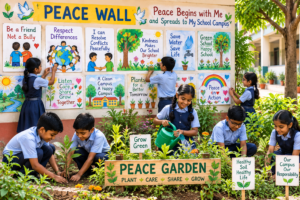
Peace Wall: Every Child Has Something to Express
A school can dedicate a wall or noticeboard to students’ creative expressions under the theme:
“Peace Begins with Me and Spreads to My School Campus.”
Each class can receive a weekly opportunity to contribute drawings, poems, short stories, questions or suggestions.
Students might illustrate how they resolved a quarrel, write about helping a friend or propose improvements to their campus.
A small student committee can rotate displays, ensuring that everyone gets an opportunity.
The Peace Wall should not become another competition. Contributions need not be ranked or awarded prizes.
Teachers can organise a short weekly discussion in which students explain their creations and listen respectfully to others.
Children thus experience expression, appreciation and mutual learning.
Peace Garden: Learning Through Caring
Even a small patch of land or a collection of containers can become a Peace Garden.
Students can bring locally suitable seeds or saplings, prepare compost from fallen leaves and maintain a watering schedule.
Small groups can take turns observing plant growth, recording rainfall, checking soil moisture and caring for the garden.
Rainwater collected safely from rooftops can be directed towards suitable recharge systems or stored for gardening where facilities permit.
Children can maintain simple records of water used and conserved.
The garden becomes a practical classroom for science, environmental responsibility, teamwork and manual labour.
Building an Inclusive Campus
Constructive activities should also strengthen relationships among students.
Classrooms can introduce a rotating friendship circle in which children invite classmates who are often left out to join games and group activities.
Traditional games can be organised so that participation matters more than winning.
Students can form small voluntary groups to welcome newcomers, assist classmates and identify campus areas needing care.
Teachers must ensure that these responsibilities are shared fairly and do not become unpaid maintenance work imposed on particular children.
A student who struggles with examinations may demonstrate leadership through gardening, painting, organising or helping others.
From Discipline to Participation
Schools must respond appropriately to bullying and violence. Alongside necessary safeguards, they can create regular opportunities for students to contribute constructively.
The Gandhi Peace Foundation, Madras, advocates such participatory approaches to peace education.
Schools could begin with one weekly creative period, one Peace Wall, a small Peace Garden and a monthly student discussion on improving campus life.
Teachers can review participation and student suggestions, adapting activities to local needs.
The essential question is not merely, “How can we control our students?” but:
“How much space and time do we give children to express their creativity for the welfare of all?”
A peaceful school culture can begin when children are trusted to create, care, cooperate and contribute.
Let every school provide time to learn, space to express and opportunities to serve.
Peace begins with me, grows through us and blossoms into the welfare of all.
Dr. S. Kulandaisamy
Secretary,
Gandhi Peace Foundation, Madras.
www.gpfmadras.org
gpfchennai@gmail.com
Leave A Comment