
- gpfchennai@gmail.com
- Mail to us
- #332 Ambujammal Street, Alwarpet, Chennai
- Address
- +91 9962860350
- Call/Connect
Peace Building Workshop | Gandhi Peace Foundation | Madras
Date: 23 July 2026
Duration: 2 Hours (10:00 a.m. – 12:00 noon)
Venue: The Children’s Garden School
Participants: 35 Students (Grades IV & V)
Resource Persons: Dr. S. Kulandaisamy & Ms. Indhumathi
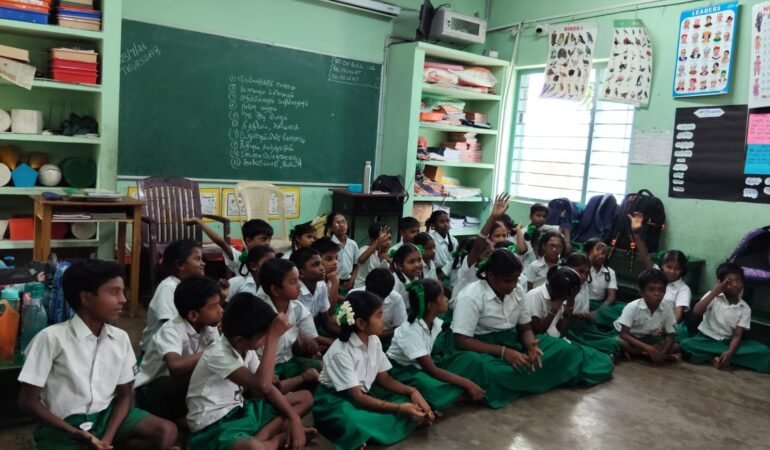
The Gandhi Peace Foundation, Madras conducted its fifth Peace Education Session for the Grade IV and V students of The Children’s Garden School. The two-hour session focused on strengthening students’ understanding of peaceful behaviour through interactive discussions, practical activities, and inclusive games.
The programme began with a recap of the Six Peace Rules introduced in the earlier sessions. Students enthusiastically recalled the rules, particularly Listen Absolutely, Get Permission to Talk, and Do Not Complain, and demonstrated how they had been practising these principles in their classrooms and at home. Their active participation reflected the positive impact of the previous sessions.
Ms. Indhumathi guided the students through discussions on applying the Peace Rules in everyday situations. The students eagerly shared their own experiences, making the session highly interactive and learner-centred.
Dr. S. Kulandaisamy conducted an engaging cooperation and concentration activity in which students stood in a circle while balancing a piece of chalk on their index fingers and moving together. After the activity, students reflected on the challenges they encountered and identified the qualities needed to succeed. They concluded that cooperation, concentration, patience, mutual support, and recognising the goodness in others are essential for achieving a common goal.
Another interactive group game encouraged students to form circles based on a given number. During the reflection, students observed that some participants were left out whenever groups were formed. This led to a meaningful discussion on inclusion, empathy, and the emotional impact of exclusion.
In a popular grouping game, students who could not form a group were usually eliminated, leaving them disappointed. We changed the rule: instead of eliminating anyone, students could stand (1), kneel (½), or squat (¼) to make the required number. This simple Gandhian innovation ensured that everyone remained in the game, experienced inclusion, and enjoyed learning mathematics through counting and fractions. The game became a joyful lesson in peace, creativity, and togetherness.
Leave A Comment