
- gpfchennai@gmail.com
- Mail to us
- #332 Ambujammal Street, Alwarpet, Chennai
- Address
- +91 9962860350
- Call/Connect
Peace Club Initiation at Two Schools in Thiruporur | Gandhi Peace Foundation | Madras
WHEN CHILDREN DISCOVER THE LIGHT WITHIN
I Knocked with Faith. The Doors—and Hearts—Opened.
Peace Club Initiation at Two Schools in Thiruporur
Thiruporur Temple
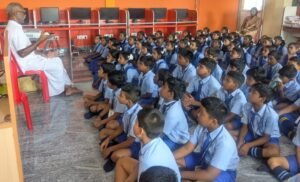
Arupadai Veedu Matriculation Higher Secondary School, Thiruporur.
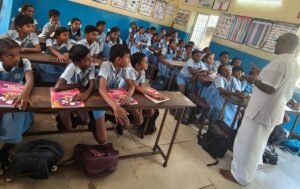
Littles Primary School, Thiruporur.
S. Kulandaisamy
Secretary, Gandhi Peace Foundation, Madras.
12 October 2026
I Went Without an Appointment
On 12 October 2026, I set out for Thiruporur with a simple intention: to help schoolchildren explore the strength hidden within themselves.
I had no prior appointment, no scheduled programme, and not even a visiting card.
I carried only faith.
I believed that school leaders would welcome someone who sincerely wished to share meaningful values with their students.
At Aarupadai Veedu Matriculation Higher Secondary School and later at Littles Primary School, I approached the headmistresses and explained my purpose.
I made one thing particularly clear:
“I have not come to advise your students or give them directions. I wish to help them discover their own inner strength. Once they discover it, they can learn to direct themselves. That inner light can guide them throughout their lives.”
To my happiness, both headmistresses welcomed me with trust and goodwill. The teachers, too, participated enthusiastically.
I knocked with faith. The doors—and hearts—opened.
Two Schools, Nearly 160 Children
The first session was held at Aarupadai Veedu Matriculation Higher Secondary School, Nemmeli Canal Road, Thiruporur, from 11:15 a.m. to 11:45 a.m., with approximately 120 students from Classes V and VI.
The second session took place at Littles Primary School, Thiruporur, from 1:00 p.m. to 1:30 p.m., with about 35–40 students.
These sessions marked the initiation of Peace Clubs under the GEN Z TO GEN P – Generation Z to Generation Peace Movement of Gandhi Peace Foundation, Madras.
I have always considered Classes V, VI, and VII particularly impressionable years. Children at this stage are curious, receptive, and capable of discovering profound values through familiar situations.
The students in both schools demonstrated this beautifully. They sat eagerly, ready to explore something new.
The Candle That Came from a Child’s Heart
I began with the story of Shantan, a young boy living in a family of eight members.
One evening, the electricity failed. Darkness filled the house. The grandparents, parents, elder sister, and other family members began complaining about the power cut.
But Shantan responded differently.
Instead of complaining, he quietly found some candles, lit them, and placed them where the family members needed light.
The darkness disappeared, and happiness returned.
I asked the children:
“Where did the light come from?”
One student at Aarupadai Veedu School gave an extraordinary response:
“The light came from the candle, of course. But really, it came from Shantan’s heart, because there was light in his heart.”
I was delighted!
The child had understood the deeper spirit of the story. The candle was merely an instrument. The real source of light was Shantan’s willingness to help others.
When I asked what they had learned, the children recognised that even a small action could bring about a big change.
A little candle had removed darkness and restored happiness to an entire family.
A Few Coins That Prevented a Quarrel
I narrated another incident involving Shantan’s father, a reputed government officer who travelled to work by bus.
He frequently carried large-denomination currency notes without keeping the exact change for the fare. This led to arguments with the conductor.
One day, the quarrel became so unpleasant that the conductor asked him to get down from the bus.
The father carried his irritation to the office and later returned home in an angry mood, shouting at his family members.
The entire household became unhappy.
Shantan quietly observed what was happening.
He neither blamed his father nor criticised the conductor. Instead, he identified the simple cause of the recurring problem.
One morning, he collected the necessary change and placed it in his father’s pocket before he left for work.
When the conductor asked for the fare, the father found the exact change.
The conductor was happy. The father was happy. Their usual argument did not arise.
The friendly atmosphere extended through the bus, the office, and eventually the home.
A small action by a child had prevented a chain of irritation and helped create a chain of happiness.
Sometimes peace begins with a candle. Sometimes, with a few coins.
From Stories to Children’s Own Actions
After the stories, I invited the students to explore their everyday experiences.
“What small positive actions can you undertake at home?”
“What can you do in your classroom?”
“What can you do to make your school a happier place?”
I encouraged them to identify their own possibilities rather than wait for instructions.
They could help someone, include a lonely classmate, avoid unnecessary quarrels, speak kindly, or resolve misunderstandings.
The message was simple:
MICRO ACTIONS FOR MACRO PEACE.
Six Rules for Peace – A 30-Day Experiment
I introduced the Six Rules for Peace:
Listen without interfering.
Get permission and speak assertively.
Do not complain to a third person; try to resolve the matter directly.
Do not blame what cannot be changed in Nature.
Do not gossip.
Accept mistakes, seek pardon, and resolve never to repeat them.
When I asked whether these rules were relevant to their lives, the children responded enthusiastically.
I invited them to practise the rules for 30 days and observe the changes in their behaviour, relationships, and inner strength.
We also explored the distinction between concentration and attention.
Concentration means focusing on a particular subject or activity.
Attention means observing the wider situation and understanding what is happening around us.
Shantan had demonstrated attention by noticing what others overlooked and finding a constructive solution.
At the end of the session, I distributed bookmarks containing the Six Rules for Peace, encouraging the children to read and practise them throughout the month.
When 120 Children Became My Friends
The most touching experience occurred at the conclusion of the session at Aarupadai Veedu School.
The teacher asked the students to form a line and leave the hall.
But instead of simply walking out, the children eagerly came towards me.
Nearly 120 students wanted to shake hands!
Some asked, “Sir, what is your name?”
I replied, “My name is Kulandaisamy.”
They were surprised.
“What? Kulandaisamy? Is that really your name?”
I explained that Kulandai means child and Samy means God or a divine being.
They laughed with delight.
“Really, Sir? Is that your actual name?”
“Yes, yes! That is really my name!”
Within moments, we had become good friends.
Several children enthusiastically told me:
“Sir, your stories are excellent!”
Their spontaneous affection overwhelmed me.
I had entered the school without an appointment or visiting card. I was leaving with nearly 120 young friends.
The Same Joy at Littles Primary School
The afternoon session at Littles Primary School was held in a smaller classroom with approximately 35–40 students.
The children listened attentively, interacted freely, and received the stories with enthusiasm.
The teachers participated happily, creating a friendly learning atmosphere.
At the conclusion, the children made a simple request:
“Sir, please come again!”
Those few words were deeply encouraging. They showed that the children wanted the joyful experience of learning and discovering together to continue.
What the Day Taught Me
The two sessions reinforced several important convictions about Peace Education.
First, children are capable of profound observation. The student who recognised the light within Shantan’s heart demonstrated how deeply children can understand a story when given the freedom to interpret it.
Second, storytelling should awaken discovery rather than impose a moral. Questions and dialogue allow children to explore their own understanding.
Third, Peace Education should develop independent judgement. Instead of directing every action, educators can help children observe situations, identify causes, and discover constructive responses.
Fourth, affection and trust create meaningful learning relationships. The openness of the headmistresses, the cooperation of the teachers, and the spontaneous friendship of the students made both sessions possible and memorable.
The initiation of these Peace Clubs is only a beginning. The 30-day practice of the Six Rules for Peace can provide opportunities for continued reflection and constructive action at home and in school.
The Light Was Already Within Them
I went to Thiruporur without an appointment, carrying faith in the goodness of people and the possibilities hidden within children.
Two headmistresses opened their schools with trust. Teachers welcomed the initiative. Nearly 160 children participated with curiosity and affection.
One child discovered that the light of a candle really came from Shantan’s heart.
Others recognised that small actions could bring happiness to many people.
And the children offered me something I had not expected: their friendship.
I went to initiate two Peace Clubs. I returned with renewed faith in the purpose of education.
I do not want to direct children throughout their lives. I want to help them discover the inner light by which they can direct themselves.
That is the spirit of Peace Education.
That is the promise of GEN Z TO GEN P.
Peace Begins with Me – and Grows Through Us.
Gandhi Peace Foundation, Madras (Regd.)
GEN Z TO GEN P – Generation Z to Generation Peace
Website: www.gpfmadras.org
Email: gpfchennai@gmail.com
Micro Actions for Macro Peace
Leave A Comment