
- gpfchennai@gmail.com
- Mail to us
- #332 Ambujammal Street, Alwarpet, Chennai
- Address
- +91 9962860350
- Call/Connect
Peace Club to Gen Peace Movement | Gandhi Peace Foundation | Madras
FROM LISTENING TO CREATIVE ACTION FOR PEACE
Report on the Fourth Peace Club Session
Ansaldo Higher Secondary School
Thazhambur, Chennai – 600130
3 November 2026
Dr. S. Kulandaisamy, Gandhi Peace Foundation, Madras
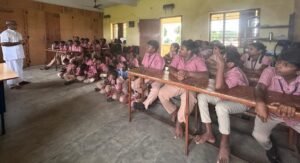
The Peace Club at Ansaldo Higher Secondary School, Thazhambur, was initiated two months ago. Its fourth session brought together the same group of students from Classes VI to XII. A remarkable change was evident, particularly in their listening, self-observation and willingness to reflect on their own behaviour.
The Peace Club does not demand silence through commands or impose discipline through external control. Instead, students and resource persons agree to a common condition: when one person speaks, everyone else remains silent and listens. If someone begins a separate conversation, the speaker pauses and waits. This agreement applies equally to everyone.
During this session, when a student was sharing the Six Rules for Peace, two students began talking. The speaker stopped and waited. The sudden silence helped them recognise their behaviour. They stopped talking, resumed listening and openly expressed regret. The first rule had become a lived experience. For nearly 90 minutes, listening remained central to the group’s sharing and reflection.
Initially, however, the students had been reluctant to speak. When I asked about the Six Rules for Peace, introduced in the first session and practised during the past month, their gestures suggested unfamiliarity or lack of interest. I felt slightly irritated. I invited them to share their experiences, but no one volunteered.
I then selected one student and encouraged him: “Share whatever you remember. Even if you do not know all six rules, I will help you.”
To my surprise, he explained every rule. He added, “By following the first rule, I could understand better what the other person was saying.”
As I invited others individually, they too recalled the rules and shared their experiences. Their initial hesitation had concealed their understanding. This was a discovery for me: the students had learned and reflected, but needed encouragement and space to express themselves.
I reminded them that the Peace Club was an opportunity to explore themselves, observe nature, discover new things and share their understanding with others.
Taking this discussion forward, I asked what differences they noticed between nature and human beings. One student observed that nature did not copy, whereas human beings often copied one another. This opened a discussion about imitation, comparison and conflict. Another student reflected that trees and birds seemed to accept what happened to them, while human beings often struggled with suffering and grievances. These were the students’ own interpretations, offering starting points for further exploration.
I then asked whether they copied in examinations. Two students openly admitted, “Yes, sir. It has become a habit.”
I appreciated their honesty and reminded the group that accepting one’s own mistake was the sixth rule for peace. I connected this courage with Gandhi’s willingness to acknowledge his mistakes and work towards correcting them. In recognition of their honest admission, I affectionately called the two students “Mahatmas.” Their acknowledgement was a first step towards change.
To deepen the discussion, I narrated a story from my collection of 150 stories about a boy nicknamed Copian, who habitually copied in examinations. His behaviour caused irritation and tension in his teacher, who was Shantan’s mother.
Shantan sincerely practised the Six Rules for Peace. He approached Copian and offered to help him learn his lessons so that he could write examinations independently. Copian accepted, reduced television viewing and unnecessary distractions, and began studying with Shantan’s help. For a month, Shantan visited his home and taught him.
When the examinations came, Copian passed every subject through his own effort. His teacher was delighted. When his surprised classmates asked how he had succeeded without copying, he replied: “Friends, be original. Do not copy others—in examinations or in life.”
Meanwhile, Shantan’s own marks rose from 70 to 90. I asked the Peace Club students how this had happened.
One student immediately replied, “Sir, when we teach a subject to a friend, it is like studying it ten times ourselves!”
His response showed an understanding of how helping others strengthens one’s own learning. The students had intelligence and insight; they needed opportunities to express and apply them.
This led to the next phase of the Peace Club—the Gen Z to Gen Peace Movement. I explained the proposal to the students, the two teachers present and the Principal, introducing the Peace Wall and Peace Garden as spaces for constructive action.
On the Peace Wall, students could display their own posters, drawings and reflections on peace values, acts of kindness and conflicts resolved without violence. Their experiences could encourage other students to participate in “Micro Actions for Macro Peace”—small, daily peace actions practised for 30 days. The school warmly welcomed the proposal.
The campus also offered considerable open space, with the school buildings occupying approximately one-tenth of the grounds. I suggested setting aside a small area for a Peace Garden, where students could bring seeds or saplings, prepare the soil and experience the wonder of nurturing growth.
A concern arose that cows roaming nearby might destroy the plants. The Principal responded confidently that the students could make a protective fence. Having planted and nurtured the saplings themselves, they would develop the interest to protect them.
Her response expressed an important educational principle: when students are given space to create something meaningful, they also have an opportunity to develop responsibility for its care. Creativity and self-discipline can grow together through constructive work.
The next Peace Club session will mark the inauguration of the Peace Wall and Peace Garden. Students will bring their creations for display. Volunteers from Gandhi Peace Foundation will join them in preparing the soil and beginning the planting activities.
The fourth session revealed how a simple listening agreement could lead to honest reflection, confident sharing and plans for collective action. Through the Gen Z to Gen Peace Movement, students will be encouraged to channel their creative energy into everyday practices of care and cooperation—small steps towards a world that blossoms into a garden of peace and harmony.
I sincerely thank the management, Principal, teachers and students for their enthusiastic participation and support.
Dr. S. Kulandaisamy
Honorary Founder Secretary
Gandhi Peace Foundation, Madras (Regd.)
Leave A Comment