
- gpfchennai@gmail.com
- Mail to us
- #332 Ambujammal Street, Alwarpet, Chennai
- Address
- +91 9962860350
- Call/Connect
157th Birth Anniversary of Mahatma Gandhi | Gandhi Peace Foundation | Madras
The questions Young India must ask (2)
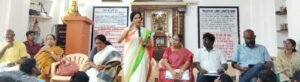 157th Birth Anniversary of Mahatma Gandhi
From Remembrance to Practice: Young People Exploring Non-violence in Everyday Life
2 October 2026 | Srinivasa Gandhi Nilayam, Alwarpet, Chennai – 18
The 157th birth anniversary of Mahatma Gandhi was commemorated by the Gandhi Peace Foundation, Madras, at Srinivasa Gandhi Nilayam, Alwarpet, Chennai, on Friday, 2 October 2026. The celebration brought together students, parents, teachers, social workers and members of the public, creating a vibrant setting in which Gandhi’s message of truth, non-violence and peaceful conflict resolution was explored by the younger generation.
Students Speak: From Competition to Experience
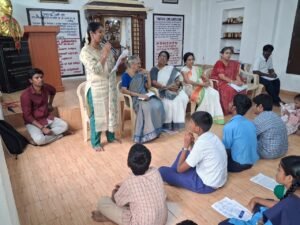
The programme began at 9.00 a.m. with a student speech session. The participating students were divided into two groups and given space in the two halls of Srinivasa Gandhi Nilayam.
The session was moderated by Mr. S. Prem and Mrs. Jubila. Significantly, they were not referred to as judges because the purpose was not to declare winners and losers. Instead, the students were encouraged to speak extempore, reflect on the given topic and, most importantly, share their own experiences of dealing with problems and conflicts in everyday life.
The moderators guided the students with sensitivity and encouragement, creating an atmosphere in which they could speak freely and honestly. The session concluded at about 10.00 a.m.
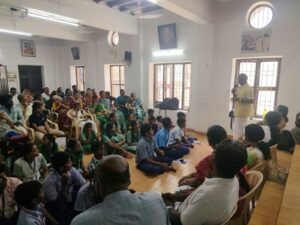
Following a short break, the main function commenced at 10.30 a.m., fifteen minutes ahead of the scheduled time, as some students who had registered for the speech session were unable to attend. The hall was filled with participating students, their parents and members of the public.
Prayer and Welcome
The programme began with a prayer offered by members of the Sri Sakthi Ganapathi Trust, which functions at Srinivasa Gandhi Nilayam.
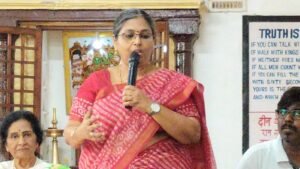
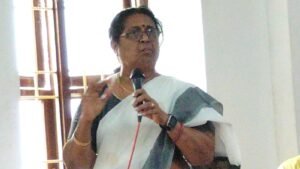
Mrs. C. Indhumathi, Administrator, Gandhi Peace Foundation, Madras, welcomed the gathering. In her address, she explained the significance of celebrating Gandhi Jayanthi in the present context and spoke about the purpose of the student speech session. She highlighted the topic given to the students and the importance of encouraging young people not merely to learn about Gandhi but also to examine how his principles can be applied in their own lives.
From Gen Z to Gen Peace
Following the welcome address, Dr. S. Kulandaisamy, Secretary of GPF, introduced the Gen Z to Gen Peace movement.
He invited all the participating students to become part of the movement through the online platform and encouraged them to undertake the 30-Day Micro-Action for Macro Peace. The initiative seeks to help young people translate the principles of peace, non-violence and constructive action into small, practical steps in their everyday lives.
The emphasis was on moving from understanding Gandhi intellectually to practising peaceful behaviour in real-life situations.
Since the idea for this movement was the brainchild of Mrs. C. Indhumathi, she was requested to launch it online on this holy day, the birthday of Mahatma Gandhi.
Thus, she declared it launched.
Five Young Voices Shared with the Public
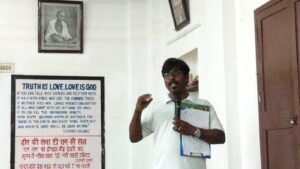
Following the presentation of the student speeches, Mr. S. Prem and Mrs. Jubila, the moderators of the morning session, shared their observations and feedback.
They appreciated the quality and sincerity of the students’ presentations and their willingness to connect Gandhi’s philosophy with situations they had actually encountered.
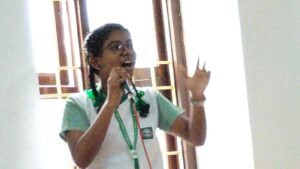
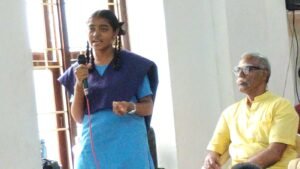
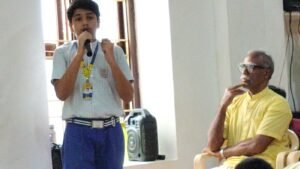
Five students were identified for particularly meaningful presentations and were invited to present their speeches again before the larger public gathering.
Their presentations demonstrated that young people can understand the relevance of Gandhi’s non-violent approach when they are given the opportunity to reflect on their own experiences.
Felicitation of the Student Speakers
The five students were felicitated by four distinguished guests:
– Mr. Prasanna
– Dr. Nirmala Alex
– Mrs. Lalitha Ramanujam
– Mrs. Geetha Gopalarathinam
In their remarks, the guests highlighted the significance of the theme chosen for the student presentations. They appreciated the ability of the young participants to understand the spirit of non-violence and to relate Gandhi’s approach to the problems they encounter in their daily lives.
They emphasized that non-violence is not merely a historical idea associated with Gandhi but a practical method of addressing disagreements and conflicts peacefully.
Padma Venkataraman: Non-violence for India and the World
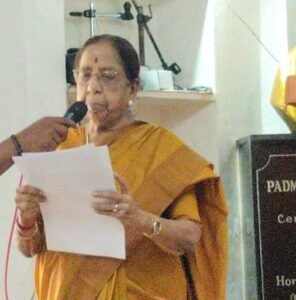
Mrs. Padma Venkataraman, President of the Women Indian Association (WIA) and Patron of the Gandhi Peace Foundation, appreciated the students for their participation and thoughtful presentations.
She emphasized the continuing relevance of non-violent methods not only for India but for the whole world. Her message reinforced the central purpose of the celebration: Gandhi’s legacy becomes meaningful when the younger generation learns to apply non-violence in their own relationships, communities and responses to conflict.
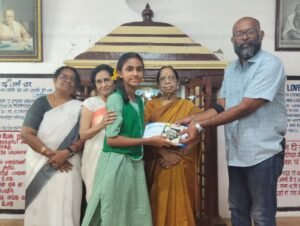
Mrs. Padma Venkataraman then awarded certificates and prizes to all the participants in the speech programme.
Recognising the Peace Ambassadors
The celebration also recognised the young people who had participated in the Peace Ambassador Project conducted one month earlier.
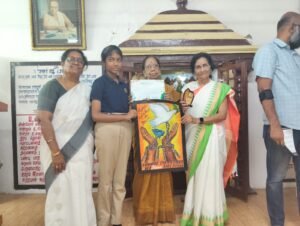
Certificates were presented to the participants who had taken part in the project. Schools that had encouraged and supported their students’ participation were also recognised with mementos.
This recognition acknowledged not only the students’ participation but also the important role played by educational institutions in creating opportunities for young people to learn, practise and promote peace.
Gandhi’s Autobiography for Every Student
As a special gesture, all the participating students were presented with a copy of Mahatma Gandhi’s autobiography.
The gift was intended to encourage the students to go beyond hearing about Gandhi during Gandhi Jayanthi and to discover his thoughts, struggles, experiments with truth and understanding of non-violence through his own writings.
A Celebration that Became an Experience
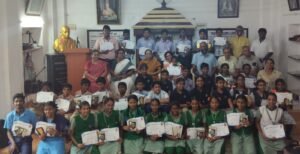
The programme concluded with a group photograph, followed by the National Anthem and lunch.
The celebration brought together a diverse gathering of students, parents, members of the public and social workers. More importantly, it created an opportunity for Gandhi Jayanthi to become a living and relevant occasion rather than merely a day of remembrance.
The young speakers demonstrated that the language of non-violence can become meaningful when it is connected with the conflicts and difficulties they actually experience in their lives.
The celebration therefore carried a simple but powerful message:
Gandhi is remembered not merely by speaking about his life but by giving the younger generation opportunities to practise his principles.
The student speech session, the Gen Z to Gen Peace movement, the 30-Day Micro-Action for Macro Peace, the recognition of Peace Ambassadors and the distribution of Gandhi’s autobiography together created a continuum—from learning about peace, to reflecting on peace, to practising peace.
The 157th Gandhi Jayanthi celebration at Srinivasa Gandhi Nilayam thus became a meaningful platform for young people to explore how non-violence can offer a practical and humane way of resolving conflicts in everyday life—and how their small actions can contribute to a more peaceful society and world.
Reported by
Mrs. C. Indhumathi
Leave A Comment